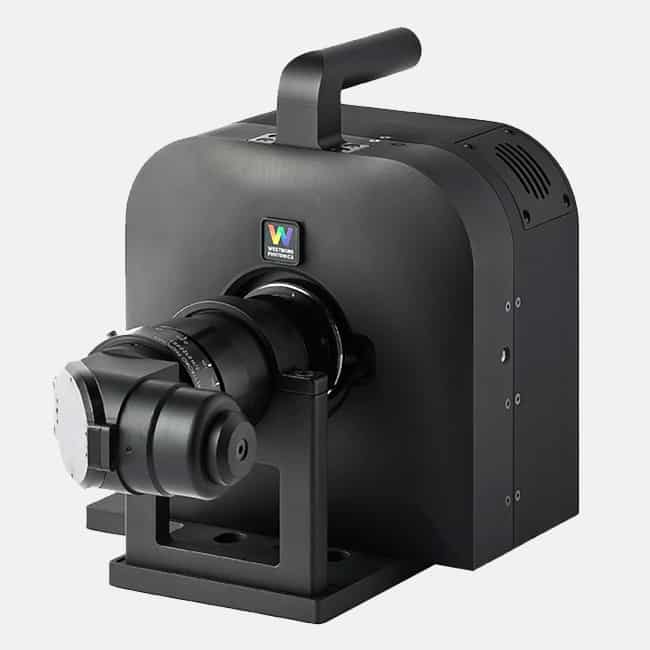
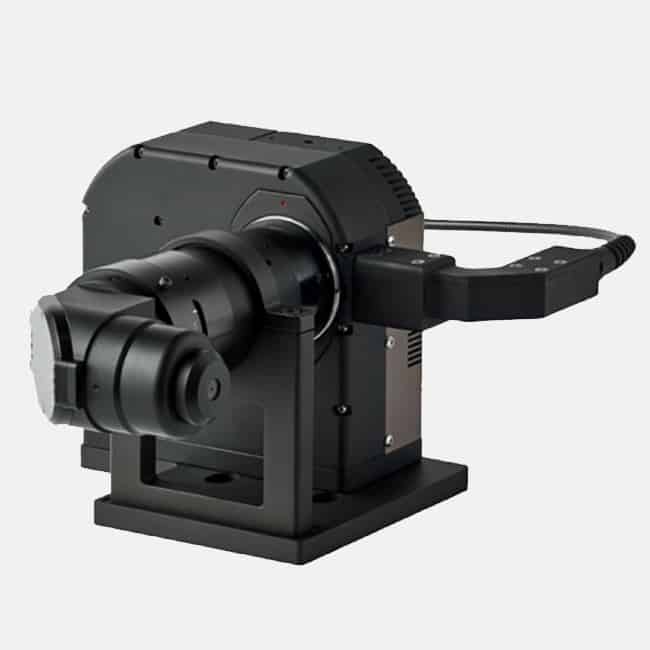
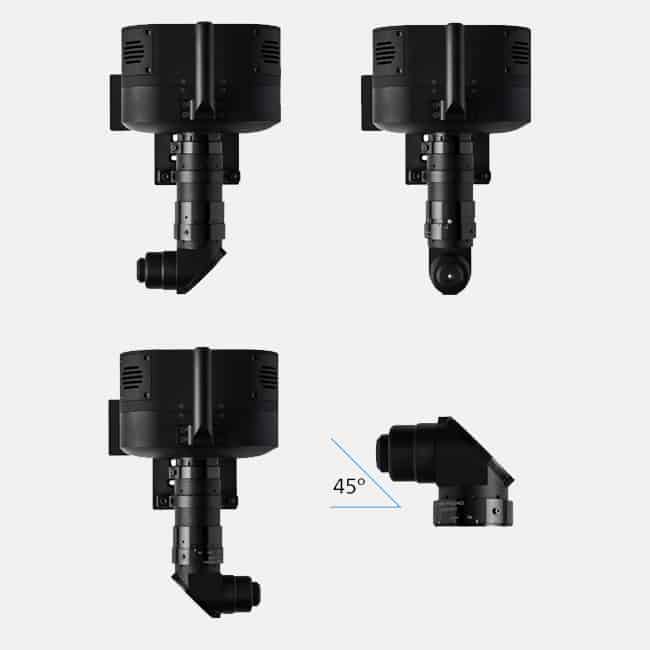
The Westboro Photonics XR1 is a periscopic near eye display (NED) lens that has been purpose designed for testing wearable displays that are used in augmented reality (AR) and virtual reality (VR) applications. The periscope design ensures the lens readily fits into the final assemblies of glasses, headsets and helmets. Under different stimuli, human visual accommodation results in varying pupil diameters. Therefore, the entrance pupil aperture is adjustable from 1.5 to 5.0mm. This lens can be fitted to the WP512 and WP525 series of imaging colorimeters or imaging spectral colorimeters.
Westboro Photonics Near Eye Display (NED) Lens Accessory for WP512 & WP525 Imaging Colorimeters
The Westboro Photonics XR1 is a periscopic near eye display (NED) lens that has been purpose designed for testing wearable displays that are used in augmented reality (AR) and virtual reality (VR) applications. The periscope design ensures the lens readily fits into the final assemblies of glasses, headsets and helmets. Under different stimuli, human visual accommodation results in varying pupil diameters. Therefore, the entrance pupil aperture is adjustable from 1.5 to 5.0mm. This lens can be fitted to the WP512 & WP525 series of imaging colorimeters or imaging spectral colorimeters.
AR/VR Wearable Near-to-Eye Display Testing
Characterising the visual performance of near-to-eye displays (NEDs) requires a special lens that emulates the optics of the human eye. To do this, Westboro Photonics’ XR1 NED Lens features an entrance pupil at the front of the lens, and its size can be changed from 1.5 mm to 5 mm — simulating typical users’ visual adaptation in bright and dark environments. The XR1 NED lens design, paired with a Westboro imaging colorimeter, enables outstanding measurement and analysis of AR and VR display systems.
Optimised For Augmented Reality Displays
The XR1 NED lens is specifically designed to provide optimal imaging performance for AR displays with up to 73° diagonal field of view (FOV).
Made to Fit
It is important that the portion of the lens near the NED is narrow and tapered so the entrance pupil (EP) of the lens is positioned at the exit pupil (XP) location of the NED. The XR1 NED lens is designed to fit the confined eye box spaces of the helmet, headset or glasses. Three features of the XR1’s design enable proper alignment:
Key Features
High Accuracy Measurements from Integrated Spectroradiometer
The XR1 NED lens is compatible with the WP512 and WP525 imaging colorimeters, which both feature integrated spectroradiometers for the highest accuracy results possible. The WP5 excels at high-speed production whereas the WP525 and WP6ES are appropriate for R&D, engineering and lower volume production.
Flexible for Research and Development
Interchangeable external entrance pupils are located at the front of the XR1 lens. Standard diameters include 1.5, 2.0, 3.0, 4.0 and 5.0mm. Custom sizes are also available. The lens can focus from 0.3m to infinity. Automation of the focus is possible via external motors. Contact SphereOptics to discuss options.
Analysis Software
All Westboro Photonics imaging systems include Photometrica software, which has the tools you need to characterise display performance including:
Compatible Colorimeters
The XR1 lens accessory is compatible with the following Westboro Photonics instruments:
The XR1 NED lens has the following specifications when used with the Westboro Photonics imaging colorimeters shown below:
| WP512 | WP525 |
Sensor Size (Megapixels) | 12.3 | 24.6 |
Angular Field of View (H° x V°) | 60×45 | 56×65 |
Entrance Pupil Sizes (mm) | 1.5, 2.0, 3.0, 4.0, 5.0, Custom | 1.5, 2.0, 3.0, 4.0, 5.0, Custom |
Focus Range (m) | 0.3 – ∞ | 0.3 – ∞ |
Luminance Range | See datasheet | See datasheet |
An imaging colorimeter is a powerful camera-based instrument that provides for vastly increased productivity compared with ‘spot’ luminance meters. A Westboro Photonics imaging colorimeter equipped with an XR1 NED lens can be used to test the MTF, contrast ratio, gamut, white point, luminance and colour uniformity and distortion of wearable augmented reality (AR) and virtual reality (VR) displays.
Datasheets
Technical Notes
Thank You
The form was submitted successfully.
Product Enquiry
Please complete all required fields.