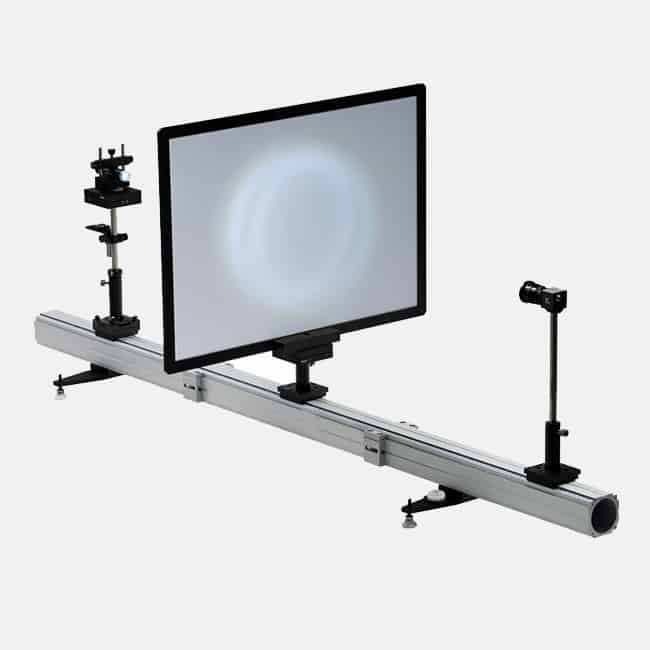
The Westboro Photonics BP100 beam pattern measurement system allows you to make fast and precise beam pattern measurements of spotlights, fiber optic illuminators and other narrow angle directional light sources. Together with a Westboro Photonics imaging photometer, the BP100 allows you to measure 2D spatial illuminance (units of lux) as well as angular luminous intensity (units of candelas). Use an imaging colorimeter instead and you can also measure the colour variation in the beam, for example to detect the inherent colour zoning that can occur from remote-phosphor LED light engines.
Westboro Photonics BP100 Beam Pattern Measurement System
The Westboro Photonics BP100 allows you to make fast and precise beam pattern measurements of spotlights, fiber optic illuminators and other narrow angle directional light sources. Together with a Westboro Photonics imaging photometer, the BP100 allows you to measure 2D spatial illuminance (units of lux) as well as angular luminous intensity (units of candelas). Use an imaging colorimeter and you can also measure the colour variation in the beam, for example to detect the inherent colour zoning that can occur from remote-phosphor LED light engines.
Intensity Measurement of Lamps
The BP100 employs a diffusely transmitting projection screen mounted on a length of optical rail to provide a flat image that can be measured by an imaging photometer. This is a low cost, versatile solution in comparison to the traditional method of measuring lamp properties as a function of angle using a goniophotometer.
Key Features
Projected Intensity vs Goniophotometric Measurements
Specialised Software
Perform a menu-driven, geometrical and photometric calibration process with Photometrica software together with the specialised Beam Pattern Software Package. The fundamental measurement parameter is the two-dimensional, spatial illuminance, reported in lux. Provided that the measurement is performed in the photometric far-field, the inverse squared rule allows for the computation of directional luminous intensity in candelas. The intensity can be reported in both polar and cartesian coordinate systems.
Without having to extend the rail or increase the screen size, the BP100 is well suited to measuring the beam patterns of lamps up to 25mm in diameter and at wide angles. You can also accommodate larger lamps with an enlarged mechanical configuration.
BP100 Beam Pattern Tester | Specification* |
Measurement Capabilities | Luminous intensity (candelas, cd) vs. angle |
Spatial Resolution | 2.3 to 12.3 Megapixels (depending on imager used) |
Angular Resolution | < 0.3° |
Luminous Intensity | 0.1 to 300,000 cd |
Illuminance | 0.2 to 750,000 lx |
Lamp to Screen Distance | 60 to 750mm |
Lamp Max Beam Angle | 28° to 144° (full angle) |
Imager to Screen Distance | 1000mm |
Weight | 6kg (excluding imager) |
Mount | 1/4” x 20 |
Max Lamp Size | ≤ 30mm (L x W x D) |
Screen Size | 50 x 38cm |
* Specifications based upon P230U 2.3MP Imaging Photometer and a screen separation of 600mm unless otherwise stated
An imaging colorimeter is a powerful camera-based instrument that provides for vastly increased productivity compared with ‘spot’ luminance meters and can be used to measure the 2D illuminance and angular luminous intensity of a directional lamp that is projected onto a diffusing screen. Applications for this technique include:
Datasheets
Technical Notes
Thank You
The form was submitted successfully.
Product Enquiry
Please complete all required fields.